Published on October 2, 2026
Hackney Carriage vs Private Hire: UK Taxi Rules Guide
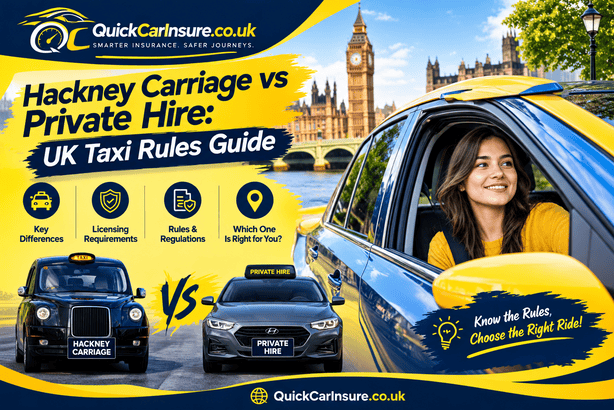
If you are thinking of becoming a professional taxi driver or switching vehicles, understanding the hackney carriage vs private hire landscape is essential. The main difference between a taxi and a private hire vehicle (PHV) comes down to how passengers book them, where they can legally operate, and how they are insured.
Hackney carriages (public hire taxis or black cabs) accept immediate street hails and pick up customers at designated ranks. Private hire vehicles (minicabs, executive cars, and rideshare vehicles like Uber) must always be pre-booked through a licensed operator.
Both transport passengers safely from A to B, but they run under completely different council regulations, licensing conditions, and insurance requirements. Standalone temporary taxi insurance from Quickcarinsure.co.uk provides fast, flexible protection tailored specifically to your vehicle's licence class.
Hackney Carriage vs Private Hire: Key Differences at a Glance
UK law strictly divides commercial passenger vehicles into two legal categories under council licensing rules:
+------------------------------------+------------------------------------+------------------------------------+
| Operational Feature                | Hackney Carriage (Public Hire)     | Private Hire Vehicle (PHV)         |
+------------------------------------+------------------------------------+------------------------------------+
| Hailing & Ranks                    | Yes (Street hails & council ranks) | Strictly pre-booked only           |
| Vehicle Roof Sign                  | Illuminated "TAXI" roof sign       | Prohibited from displaying roof sign|
| Fare & Meter Rules                 | Council-calibrated taximeter       | Agreed upfront or via app algorithm|
| Door Stickers & Plates             | Council rear/front bumper plates   | "Pre-booked Only" door stickers    |
| Insurance Type Required            | Public Hire Taxi Insurance         | Private Hire Taxi Insurance        |
+------------------------------------+------------------------------------+------------------------------------+
The Fleet Shift: Changing Popularity of Taxis vs PHVs
Department for Transport (DfT) taxi statistics highlight a dramatic transformation across the UK taxi trade:
-
The Fleet Reversal: In 2005, hackney carriages accounted for nearly 35% of all licensed vehicles in England. Today, private hire vehicles make up over 84% of the total national fleet.
-
Rapid PHV Expansion: Driven by smartphone apps and digital booking platforms, the private hire fleet has expanded significantly, providing flexible working hours for thousands of drivers.
-
App-Based Convenience: Following shifts in travel habits, passengers increasingly prefer upfront fare transparency and app-based booking, making PHV driving one of the fastest-growing sectors in UK road transport.
Common Questions About Taxi Classifications
Is a Private Hire Vehicle Classed as a Taxi?
Legally and for insurance purposes, a private hire vehicle is not classed as a taxi. While the general public uses the word "taxi" loosely, a PHV can only take passengers who have booked in advance through a licensed operator dispatch system.
What Is the Difference Between a Taxi and a Hackney Carriage?
There is no legal difference. "Hackney carriage" is the official legal terminology used in council licensing rules, while "taxi" or "black cab" is the everyday term used by the public.
Is Uber Private Hire or Hackney Carriage?
Uber is a licensed private hire operator. Drivers working for Uber, Bolt, or regional minicab firms drive private hire vehicles and must accept every fare through the app prior to passenger pickup.
Dual Badges & Licensing Requirements
To operate legally, you must hold a professional driver licence issued by your local council or Transport for London (TfL). Obtaining a licence requires:
-
Enhanced DBS Check: Criminal record and background checks.
-
Medical Fitness Assessment: Completed by a registered doctor.
-
Local Knowledge or Navigation Assessment: Geographical checks for the operating region.
-
Practical Driving Assessment: Specialist driving evaluation administered by licensing authorities.
In many local council areas outside London, authorities issue a dual driver licence. A dual licence permits you to drive both hackney carriages and private hire vehicles under a single badge, giving you the flexibility to work app shifts on weekdays and take rank fares on busy weekend nights.
Public Hire vs Private Hire Taxi Insurance
Because public hire and private hire driving involve different operational risks, insurers treat them as distinct products:
Public Hire Taxi Insurance
Covers vehicles licensed to pick up unscheduled passengers from ranks or street hails. Because passengers are picked up without prior digital logs, insurers classify this as a higher risk profile requiring public liability and plying-for-hire protection.
Private Hire Taxi Insurance
Covers vehicles that carry out pre-booked trips dispatched by a licensed operator. Because every trip and destination is logged on a central booking system before pickup, risk profiles differ from rank work. Accepting unbooked street hails in a private hire car is illegal and immediately voids your insurance policy.
Get Covered Instantly with Quickcarinsure.co.uk
Whether you operate a traditional hackney carriage or drive for a private hire operator, holding valid, flexible cover protects your daily earnings and keeps your badge secure.
With Quickcarinsure.co.uk, setting up temporary taxi insurance is simple:
-
Flexible Duration: Get short-term cover tailored to your working schedule.
-
Instant Digital Setup: Complete your quote and secure official policy documentation online in under two minutes.
-
Full Legal Protection: Standalone comprehensive cover designed to meet local authority standards.
Visit Quickcarinsure.co.uk today, get your instant short-term taxi insurance quote, and hit the road with complete confidence!