Published on October 1, 2026
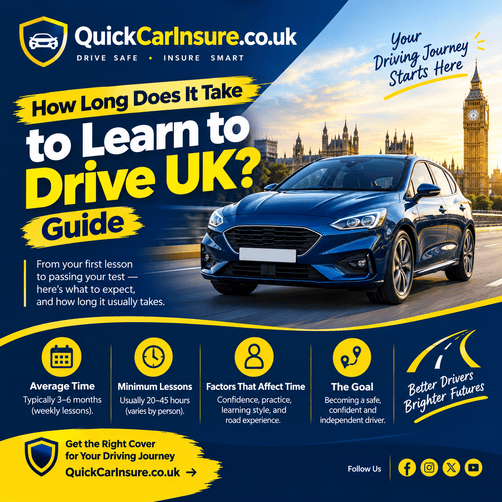
How Long Does It Take to Learn to Drive UK? Guide
If you are getting behind the wheel for the first time, you are probably wondering how long it takes to learn to drive. How many hours it takes depends on a range of personal factors, including how consistently you practice, whether you choose manual or automatic, and how confident you feel on the road.
In the official DVSA Ready to Pass? campaign, road safety experts emphasize that reaching test standard isn’t about hitting a magic number of hours—it’s about building complete driving independence. Reaching test standard quickly requires combining regular professional tuition with private practice using standalone learner driver insurance.
At Quickcarinsure.co.uk, flexible temporary learner driver cover gets you insured on a parent's or friend's car in under two minutes so you can start building skills right away.
When Can You Start Driving Lessons in the UK?
Before planning your driving schedule, you need to know the legal requirements for getting started on public roads:
-
Licence Age: You can apply for a UK provisional driving licence at 15 years and 9 months old.
-
Starting Road Lessons: You cannot take lessons on public roads until you turn 17 (unless you receive the enhanced rate of the mobility component of PIP, which permits driving at 16).
+------------------------------------+------------------------------------------------------------------+
| Legal Requirement                  | Criterion Details                                                |
+------------------------------------+------------------------------------------------------------------+
| Provisional Licence                | Must hold a valid UK provisional licence before taking the wheel. |
| Qualified Supervision              | Must be supervised by an ADI instructor or eligible driver (21+).|
| Valid Insurance Cover              | Standalone provisional driver cover required for the specific car.|
+------------------------------------+------------------------------------------------------------------+
Driving without valid cover is a major offence that can jeopardise your driving record before it begins. Provisional drivers need insurance every single time they take the driver's seat—even for a quick 10-minute session practising bay parking in a family car.
Average Hours Needed to Pass the Driving Test
Breaking down required hours helps keep your training schedule on track. The DVSA benchmark suggests 45 hours of professional tuition plus 22 hours of private practice. However, the DVSA has moved away from strict hour targets to encourage learners to focus on actual readiness rather than hitting arbitrary numbers.
Common Driving Lesson Structures
Most approved driving instructors (ADIs) offer lessons in three standard time slots:
-
1-Hour Lessons: Often feel rushed because setup, recapping previous skills, and parking up consume a large portion of the session.
-
1.5-Hour Lessons: A solid middle ground that offers plenty of practical driving time without triggering mental fatigue.
-
2-Hour Lessons: Generally considered the most efficient format. A 2-hour session provides enough time to explore complex road layouts, practice manoeuvres, and build muscle memory.
Estimated Timeline: Lessons vs Learning Pace
The overall calendar time required to pass depends on your schedule, budget, and access to private practice:
+------------------+---------------------+------------------------+--------------------+
| Learning Pace    | Weekly Lesson Hours | Typical Private Practice| Estimated Duration |
+------------------+---------------------+------------------------+--------------------+
| Intensive Course | 15–30 hours / week  | Minimal                | 2 to 4 weeks       |
| Fast-Track Pace  | 4 hours / week      | 2–3 hours / week       | 2 to 3 months      |
| Standard Pace    | 2 hours / week      | 1–2 hours / week       | 5 to 6 months      |
| Relaxed Pace     | 1 hour / week       | None                   | 9 to 12 months     |
+------------------+---------------------+------------------------+--------------------+
Manual vs Automatic: Which Option Is Faster?
Choosing between a manual and an automatic car directly impacts your total required lesson hours:
1. Automatic Transmission
On average, automatic learners reach test readiness faster—typically taking 30 to 35 hours of professional instruction. Without a clutch pedal or gear stick to manage, you can focus entirely on steering, road positioning, and hazard perception.
2. Manual Transmission
Learning manual usually requires 40 to 50 hours of tuition. Mastering clutch control, finding the bite point, perfecting hill starts, and making smooth gear changes add an extra layer of coordination that requires dedicated time to turn into muscle memory.
Key Factors That Accelerate Your Progress
No two learners progress at the exact same speed. Several variables influence your personal timeline:
-
Lesson Consistency: Regular weekly sessions keep information fresh. Gaps of two or three weeks mean spending valuable lesson time re-learning old skills.
-
Private Practice: Supplementing professional lessons with private practice is the most effective way to cut down required instructor hours.
-
Early Theory Test Completion: Passing your theory test early prevents delays when booking your practical test once you reach test standard.
-
Instructor Compatibility: Finding an instructor whose communication style makes you feel relaxed speeds up skill absorption significantly.
-
Varied Driving Conditions: Driving in heavy traffic, night conditions, rainy weather, and rural roads prepares you for real-world driving far faster than sticking to quiet residential streets.
How Private Practice Helps You Learn Faster
Private practice with a family member or friend lets you repeat skills taught by your instructor without paying hourly tuition fees. It builds muscle memory for everyday scenarios like parking at the supermarket or navigating local roundabouts.
To practice legally, you need dedicated insurance cover. Temporary learner cover from Quickcarinsure.co.uk provides fully comprehensive protection for the exact duration you need—from a single hour up to several weeks—without risking the car owner's No Claims Discount.
Tips for Passing Your Practical Test First Time
According to official DVSA data, the national practical pass rate in Great Britain sits at 50%. To maximize your chances of passing on your first attempt:
-
Take Mock Tests: Ask your instructor to conduct full mock tests under realistic test conditions to build familiarity with test pressure.
-
Select the Right Test Time: Traffic conditions vary throughout the day; select a time slot that matches your driving confidence.
-
Practice in Your Test Car: If taking the exam in a family car, ensure you have dedicated driving test cover in place so you are fully protected on the day.
Get Instant Learner Driver Insurance with Quickcarinsure.co.uk
Ready to get those extra private practice hours in? Arranging flexible short-term learner driver insurance with Quickcarinsure.co.uk is fast and straightforward:
-
Instant Digital Setup: Get covered online in under two minutes.
-
Protect the Owner's NCD: The vehicle owner's No Claims Bonus remains 100% untouched in the event of a claim.
-
Flexible Durations: Choose short-term cover for an hour, a day, or multiple weeks as you build your confidence.
Get your instant learner driver insurance quote at Quickcarinsure.co.uk today and take your driving test with total confidence!