Published on June 29, 2026
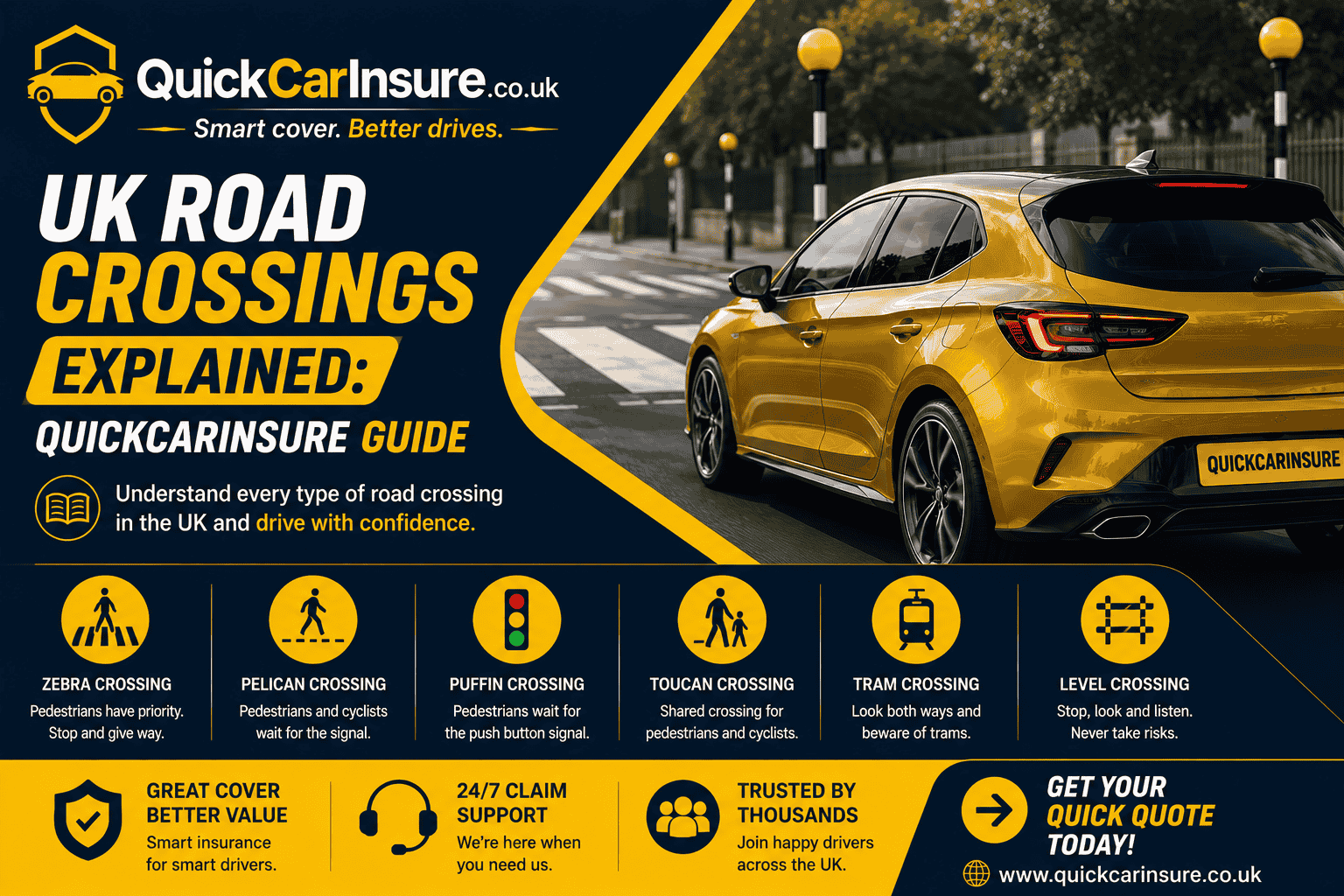
UK Road Crossings Explained: Quickcarinsure Guide
Road crossings are a fundamental pillar of highway safety in the UK. Designed to manage the flow of traffic while protecting pedestrians, cyclists, and horse riders, navigating them correctly is essential for everyone on the road.
Whether you are an experienced motorist, a pedestrian, or a learner driver preparing for your practical test, Quickcarinsure.co.uk breaks down everything you need to know about identifying and tackling the UK’s different road crossings.
Controlled vs. Uncontrolled Crossings: What’s the Difference?
All road crossings in the UK fall into one of two distinct categories:
-
Controlled Crossings: These utilize active traffic management systems—such as electronic light signals or physical stop signs—to halt vehicular traffic and grant clear priority to pedestrians.
-
Uncontrolled Crossings: These lack automated lights or active signals. Pedestrians must use their own judgment, waiting for a safe gap in traffic or for approaching vehicles to come to a complete stop before stepping onto the tarmac.
Uncontrolled Road Crossings
1. Zebra Crossings
Characterized by bold black and white stripes painted across the road surface, Zebra crossings are accompanied by flashing yellow globes known as Belisha beacons positioned on the pavement.
-
For Drivers: By law, you must approach with caution and give way to any pedestrian who has stepped onto, or is waiting to use, the crossing.
-
For Pedestrians: Always wait until you see that approaching vehicles have visibly slowed down or stopped before walking across.
2. School Warden Crossings
Commonly found near primary and secondary schools during drop-off and pick-up hours, these are actively managed by a school crossing patrol (often called "lollipop men or women").
-
For Drivers: When a warden steps into the road displaying a high-visibility circular 'STOP' sign, you are legally mandated to come to a complete halt. Failing to stop is a severe driving offence.
-
For Pedestrians: Wait safely on the pavement until the warden gives you a clear signal that traffic has been fully stopped.
Controlled Road Crossings
The UK uses a distinct "bird-themed" naming convention for its light-controlled pedestrian crossings.
1. Pelican Crossings
Pelican crossings are manually operated by pedestrians via a push-button unit. Once pressed, the traffic lights cycle to red, stopping the cars. They feature zig-zag road markings on approach to warn drivers not to park or overtake near the zone.
The Flashing Amber Phase: Pelican crossings are unique because they feature a flashing amber light sequence for drivers. During this phase, motorists must continue to give way if pedestrians are still on the crossing. However, if the crossing is completely clear, drivers are legally allowed to proceed.
2. Puffin Crossings
Puffin (Pedestrian User Friendly Intelligent) crossings look identical to Pelican crossings from a distance, but they operate using smart technology. They feature built-in infrared sensors that monitor the crossing.
-
How they work: If a slow-moving pedestrian needs more time, the sensors keep the traffic light red for longer. If a pedestrian pushes the button but walks away, the system cancels the request to keep traffic flowing smoothly.
-
Visual difference: The "Green Man" signal is located on the button box itself at the side of the road, rather than across the street.
3. Toucan Crossings
Designed with a "two-can" philosophy, Toucan crossings are wider installations built specifically for both pedestrians and cyclists to share simultaneously.
-
Key benefit: Unlike regular crossings where cyclists are legally required to dismount and push their bicycles, cyclists can safely ride across a Toucan crossing.
-
Identification: The light display features both a green bicycle symbol alongside the traditional green man.
4. Equestrian (Pegasus) Crossings
Specifically adapted for horse riders, these are typically situated near bridleways, racecourses, or rural parklands.
-
Key features: They feature a wider crossing path and include a secondary, elevated push-button panel placed high up on the post, allowing riders to activate the crossing without dismounting.
-
Signals: The automated light panel displays a distinct green horse symbol.
Best Practices for Road Safety
To keep UK roads accident-free, both drivers and pedestrians should maintain high situational awareness.
For Pedestrians:
-
Always utilize designated crossing zones rather than jaywalking on busy stretches.
-
Do not assume a vehicle will stop instantly; look both ways and confirm wheels have stopped rolling before stepping off the kerb.
For Drivers:
-
Scan ahead for warning triangles, zig-zag lines, and flashing beacons, especially in built-up urban centers.
-
Never block a road crossing. Even in dense, stationary gridlock traffic, you must leave the crossing area completely clear for pedestrians.
Master the Roads with Quickcarinsure.co.uk
Navigating these crossings perfectly is a core requirement to pass your DVSA Theory and Practical Driving Tests. Examiners pay strict attention to how you manage your speed, positioning, and awareness when approaching pedestrian crossings.
The finest way to build your confidence and master these road rules is through extensive, real-world driving practice. If you are learning to drive or practicing in a friend or family member's car, making sure you have independent insurance cover is vital.
At Quickcarinsure.co.uk, we offer highly flexible, fully comprehensive temporary learner driver insurance. With coverage options stretching from 1 day up to 5 months, you can practice your road skills with absolute peace of mind.
Get an instant quote with Quickcarinsure.co.uk today and perfect your driving skills!