Published on September 28, 2026
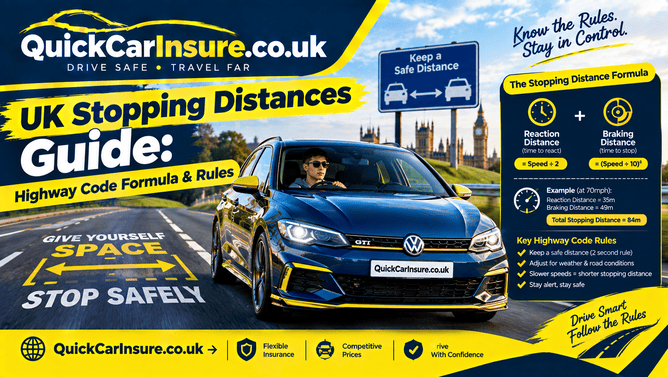
UK Stopping Distances Guide: Highway Code Formula & Rules
Whether you are a learner driver studying for your UK theory test or an experienced motorist refreshing your road knowledge, understanding Highway Code stopping distances is crucial for road safety.
Knowing the exact distance required to bring a vehicle to a complete standstill helps you maintain safe tailing gaps, anticipate potential hazards, and prevent costly rear-end collisions.
In this comprehensive guide, we cover Highway Code stopping formulas, speed-by-speed calculations, environmental risk factors, and how flexible short-term cover through Quickcarinsure.co.uk keeps you legally protected during private driving practice.
What Is Stopping Distance?
According to the UK Highway Code, overall stopping distance is defined as the total distance a moving vehicle travels from the precise moment a driver spots a hazard to when the car comes to a complete standstill.
Overall stopping distance consists of two distinct components:
-
Thinking Distance: The distance your vehicle travels while you react to a hazard, decide to stop, and physically press the brake pedal.
-
Braking Distance: The distance your vehicle travels after the brakes are applied until the car comes to a complete stop.
UK Highway Code Stopping Distances at a Glance
The Highway Code calculates official stopping distances based on an average UK car length in dry, clear conditions:
+---------+--------------------+-------------------+-------------------------+--------------------+
| Speed   | Thinking Distance  | Braking Distance  | Total Distance (Metres) | Total Distance (Ft)|
+---------+--------------------+-------------------+-------------------------+--------------------+
| 20 mph  | 6 metres (20 ft)   | 6 metres (20 ft)  | 12 metres               | 40 feet            |
| 30 mph  | 9 metres (30 ft)   | 14 metres (45 ft) | 23 metres               | 75 feet            |
| 40 mph  | 12 metres (40 ft)  | 24 metres (78 ft) | 36 metres               | 120 feet           |
| 50 mph  | 15 metres (50 ft)  | 38 metres (125 ft)| 53 metres               | 175 feet           |
| 60 mph  | 18 metres (60 ft)  | 55 metres (180 ft)| 73 metres               | 240 feet           |
| 70 mph  | 21 metres (70 ft)  | 75 metres (245 ft)| 96 metres               | 315 feet           |
+---------+--------------------+-------------------+-------------------------+--------------------+
Theory Test Memory Trick: How to Calculate Distances in Seconds
Memorizing exact metres and feet for your theory test can feel tricky. Luckily, there is a simple mathematical shortcut to calculate total stopping distances in feet:
Multiply your speed (in mph) by a factor that increases by 0.5 for every 10 mph increase, starting at 2 for 20 mph:
-
20 mph: (12 metres)
-
30 mph: (23 metres)
-
40 mph: (36 metres)
-
50 mph: (53 metres)
-
60 mph: (73 metres)
-
70 mph: (96 metres)
(To convert feet into metres, divide the result by approximately 3.3).
Factors Affecting Thinking Distance
On average, a driver's reaction time is approximately 0.7 seconds. However, several critical factors increase reaction time and thinking distance:
-
Alcohol & Drugs: Impair cognitive processing speeds, drastically delaying brake application.
-
Mobile Phones & In-Car Distractions: Adjusting sat-navs, radios, or talking to passengers diverts visual and mental attention away from the road.
-
Driver Fatigue: Sleep deprivation slows reflexes and reduces spatial awareness. Motorists should take a 15-minute break every two hours during long journeys.
-
Poor Visibility: Rain, fog, or nighttime darkness makes identifying hazards down the road harder, delaying reaction times.
Factors Affecting Braking Distance
Even if your reaction time is lightning fast, physical factors can extend how far your car travels after applying the brakes:
-
Adverse Weather: Wet roads reduce tyre grip, requiring at least double the standard stopping distance. On icy roads, braking distances can increase up to 10 times.
-
Tyre Condition & Inflation: Worn tread or incorrect tyre pressure lowers friction against the road surface, increasing slide distance.
-
Vehicle Weight: Fully loaded vehicles or cars towing trailers carry greater momentum, requiring extra braking force and longer distances to halt.
-
Brake Wear: Faulty or worn brake pads and discs significantly degrade stopping power.
The 2-Second Rule vs 4-Second Rule
The 2-Second Rule is a practical method to ensure a safe gap between you and the vehicle ahead in dry conditions:
-
Pick a stationary object ahead (e.g., a road sign, bridge, or lamp post).
-
When the vehicle in front passes the object, count: "One thousand and one, one thousand and two."
-
If you reach the fixed point before finishing the count, you are tailgating and should drop back.
Crucial Weather Adjustment: In rain or wet conditions, double the gap to 4 seconds. In icy or snowy weather, extend the gap up to 20 seconds.
Drive Safe & Stay Fully Covered with Quickcarinsure.co.uk
Mastering stopping distances during private practice sessions is vital for building confidence behind the wheel. Whether you are a learner driver practicing in a family car or borrowing a vehicle for a weekend trip, having valid insurance is essential.
Adding a temporary driver to an annual policy can be expensive and risks the owner’s No Claims Discount (NCD). Standalone learner driver insurance and temporary car insurance from Quickcarinsure.co.uk offers flexible, fully comprehensive protection:
-
Protect the Owner’s NCD: The vehicle owner's policy remains 100% untouched if an accident occurs.
-
Flexible Short-Term Durations: Get covered from 1 hour up to 28 days.
-
Instant Digital Setup: Secure cover online in under two minutes directly on your phone.
Stay safe on the road, leave plenty of stopping room, and visit Quickcarinsure.co.uk today for an instant short-term insurance quote!